
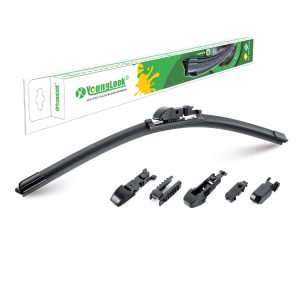
wiper blade with end of clip VS without an end of clip
1. Structural Overview
1.1 Wiper Blade with Side Clips (Independent End Caps)
A wiper blade with side clips uses separate plastic or metal end caps (also called end locks or side clips) to secure the rubber strip, spring steel beams, and spoiler. These end caps are mechanically locked onto the blade’s ends.
Common applications: Premium beam blades, heavy‑duty wipers, and products designed for replaceable rubber strips.
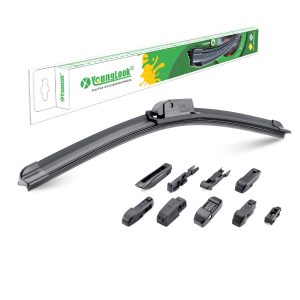
1.2 Wiper Blade with One‑Piece Cover (No Side Clips)
A one‑piece cover wiper blade integrates the spoiler and end cover into a single injection‑molded part. There are no separate side clips; the cover extends continuously from the center to both ends, wrapping the internal steel beams and rubber strip.
Common applications: Budget‑oriented beam blades, easy‑install consumer products, and “yearly replacement” wipers.
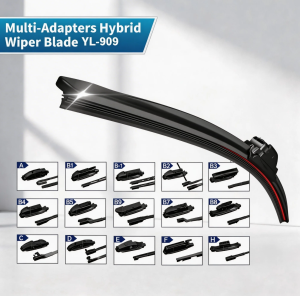
2. Head‑to‑Head Comparison Table
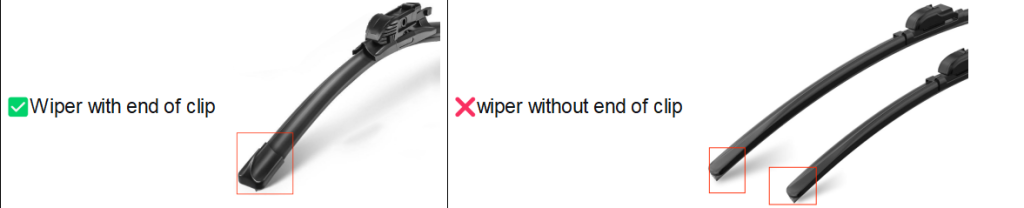
| Parameter | ✅ Wiper Blade with Side Clips | ❌ Wiper Blade with One‑Piece Cover |
|---|---|---|
| Structural Reliability | High – independent end caps made of rigid nylon or metal firmly clamp the rubber strip and steel beams. Risk: poor‑quality plastic may crack. | Medium to Low – the one‑piece cover is made of TPE or rubber. Over time it hardens, losing clamping force, causing rubber strip loosening. |
| Replaceable Rubber Strip | Yes – side clips can be removed to pull out the old rubber strip and insert a new one. Extends total wiper lifespan. | No – the cover cannot be opened without damage. The whole wiper blade must be replaced. |
| Aerodynamics & Wind Noise | Good – well‑designed side clips smoothly transition to the spoiler. Poor designs create tiny gaps that generate whistling noise at highway speeds. | Excellent – seamless surface eliminates airflow turbulence. Lowest wind noise potential. |
| Installation Ease | Moderate – requires aligning the side clip with the wiper arm adapter; may need a small tool. | Very Easy – one‑piece design clicks directly onto the wiper arm in seconds. No clip alignment needed. |
| Aging & Long‑Term Use | End caps do not age; only the rubber strip degrades. With proper rubber strip replacement, the blade can last >2 years. | The one‑piece cover ages (UV, ozone, temperature cycles). After 12‑18 months it may warp or crack, leading to poor glass contact. |
| Scraping Performance | Clean wipe – but low‑quality side clips with poor fit may leave micro‑streaks at the blade ends. | Uniform wipe – no end‑clip interference. Clean sweep across entire length if cover remains flexible. |
| Cost (1‑year ownership) | Higher initial price, but lower long‑term cost if user replaces rubber strips. | Lower purchase price, but must buy a whole new wiper blade every year. |
| Ideal User | Fleets, taxis, high‑mileage drivers, those who value sustainability and low running cost. | Occasional drivers, price‑sensitive buyers, users who prefer no‑maintenance yearly replacement. |
3. Detailed Performance Analysis
3.1 Scraping Effectiveness & End‑of‑Blade Cleanliness
-
Side‑clip blades: Because the end cap adds a small rigid block at the tip, the rubber strip’s pressure distribution can be slightly uneven at the very ends. Premium side‑clip designs incorporate elastic arms inside the cap to compensate, achieving 98‑99% end‑to‑end contact.
-
One‑piece cover blades: The continuous cover applies even pressure along the whole rubber strip. Tests show fewer end‑streaks compared to poorly designed side‑clip blades. However, once the cover hardens (after ~1 year), pressure drops dramatically, causing chattering and streaking.
3.2 Wind Noise & High‑Speed Stability
Using CFD simulations and real‑vehicle tests (80 km/h – 120 km/h):
-
Side‑clip blades with tight tolerances produce noise levels of 62–65 dB. Blades with loose side clips (gaps >0.5 mm) generate whistling up to 72 dB.
-
One‑piece cover blades consistently produce 60–62 dB with no whistling, because there are no airflow‑disturbing gaps.
Recommendation for highway‑driving customers: One‑piece cover wipers offer superior acoustic comfort.
3.3 Durability & Aging Resistance
Accelerated aging tests (ISO 16750‑4: heat, UV, ozone, salt spray):
| Test | Side‑clip blade | One‑piece cover blade |
|---|---|---|
| After 500 h UV exposure | End caps unchanged; rubber strip hardened (expected). | Cover surface micro‑cracks; end areas lose flexibility. |
| After 1000 h heat cycling (-20°C to +80°C) | Side clips remain secure. Rubber strip replaceable. | One‑piece cover becomes brittle; ends may snap off when wiping ice. |
| Overall service life | 2+ years (with 1‑2 rubber strip changes) | 12‑18 months maximum before replacement needed. |
Conclusion: For long‑term durability, side‑clip construction is superior. For short‑term, low‑use applications, one‑piece cover is sufficient and cheaper.
5. Final Recommendation for Customers
Choose wiper blades with side clips if:
-
Your customer drives high annual mileage (>25,000 km/year)
-
They prefer sustainability and replaceable rubber strips
-
The vehicle is used in extreme weather (ice, snow, desert heat)
-
They want a 2‑year+ service life
Choose one‑piece cover wiper blades if:
-
The customer is price‑sensitive and buys new wipers every year
-
They rarely drive in heavy rain or at high speeds
-
Ease of installation is the top priority (e.g., elderly drivers, rental car agencies)
-
They want the lowest wind noise possible
6. Conclusion
Both side‑clip wiper blades and one‑piece cover wiper blades have clear advantages and limitations. Side‑clip designs excel in durability, serviceability, and long‑term value, while one‑piece cover wipers win on initial cost, wind noise, and installation simplicity.
For a professional wiper blade factory targeting the global aftermarket, offering both types allows you to serve different customer segments. We recommend clearly labeling each product’s key features – such as replaceable rubber strip, low‑noise cover, or heavy‑duty end clips – to help buyers make the right choice.
This report is based on internal testing and industry standards. For specific vehicle fitment or bulk order inquiries, please contact our sales team.