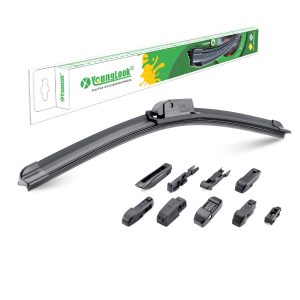
Why do some windshield wiper blades last longer, wipe more quietly and maintain better performance than others, even when they look almost identical?
One important reason is the quality of the wiper blade rubber.
The rubber wiping edge makes direct contact with the windshield. Its flexibility, friction characteristics, wear resistance and resistance to environmental aging all influence the driver’s visibility and comfort.
However, rubber quality is more complicated than simply choosing between natural rubber and silicone. Manufacturers use different rubber compounds, reinforcement systems, vulcanization processes and surface coatings.
Some suppliers also describe their products as A-grade natural rubber or AA-grade natural rubber, although these terms do not represent universally standardized quality classifications for finished wiper rubber.
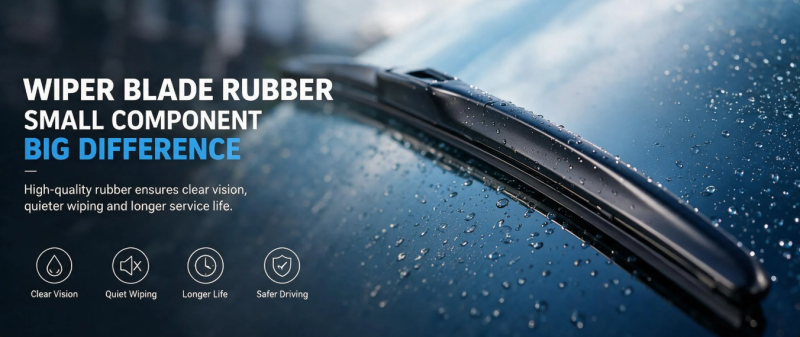
Wiper blade rubber grades A and AA, surface coatings, and material durability dictate how well a blade cleans your windshield and how long it lasts。For importers, distributors and private-label brands, understanding these differences helps avoid poor purchasing decisions and unnecessary warranty claims.
This guide explains how rubber grades, formulations and coatings affect performance, how manufacturers test rubber quality and what buyers should consider when sourcing OEM windshield wiper blades.
1. What Is Wiper Blade Rubber and Why Does Quality Matter?
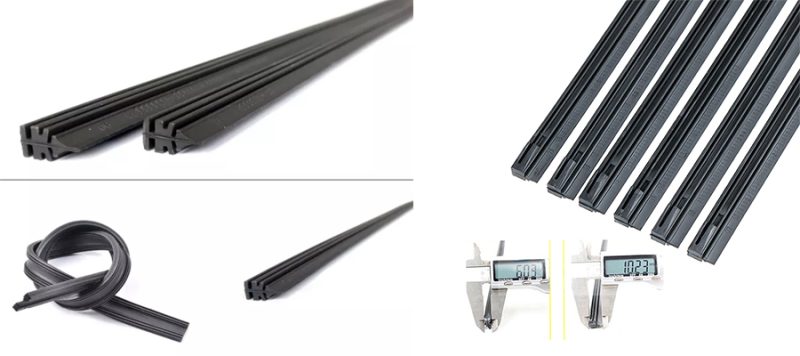
How Wiper Rubber Works
The wiper rubber refill is the flexible component that contacts the windshield and removes water.
During operation, the rubber lip moves across the glass while repeatedly changing direction. It must maintain sufficient contact pressure without creating excessive friction or vibration.
A good rubber compound needs an appropriate balance of flexibility, stiffness, elastic recovery and resistance to wear.
The finished blade’s spring steel, frame geometry and wiper arm pressure also influence the result.
Why Similar Wiper Blades Perform Differently
Two flat wiper blades can have the same appearance, length and adapter system but use different rubber formulations.
One may prioritize low production cost, while another uses a more carefully controlled compound, improved anti-aging protection or a different surface coating.
Both may initially wipe well. Their differences can become more noticeable after repeated use or exposure to heat and ozone.
This is why buyers should evaluate more than appearance and price.
Common Rubber-Related Wiping Problems
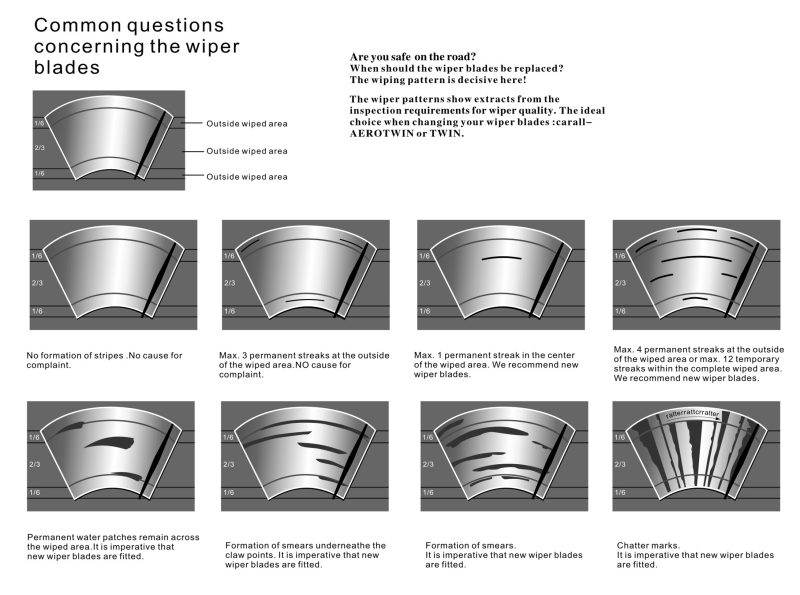
Typical symptoms include wiper blade streaking, squeaking, chattering, cracking and uneven wiping.
These can result from rubber aging, damaged wiping edges or unstable friction.
However, contaminated glass, incorrect installation and unsuitable wiper arm pressure can cause similar problems.
For a broader explanation of how materials and structure work together, read our windshield wiper blade manufacturing process guide
2. What Materials Are Used in Windshield Wiper Rubber?
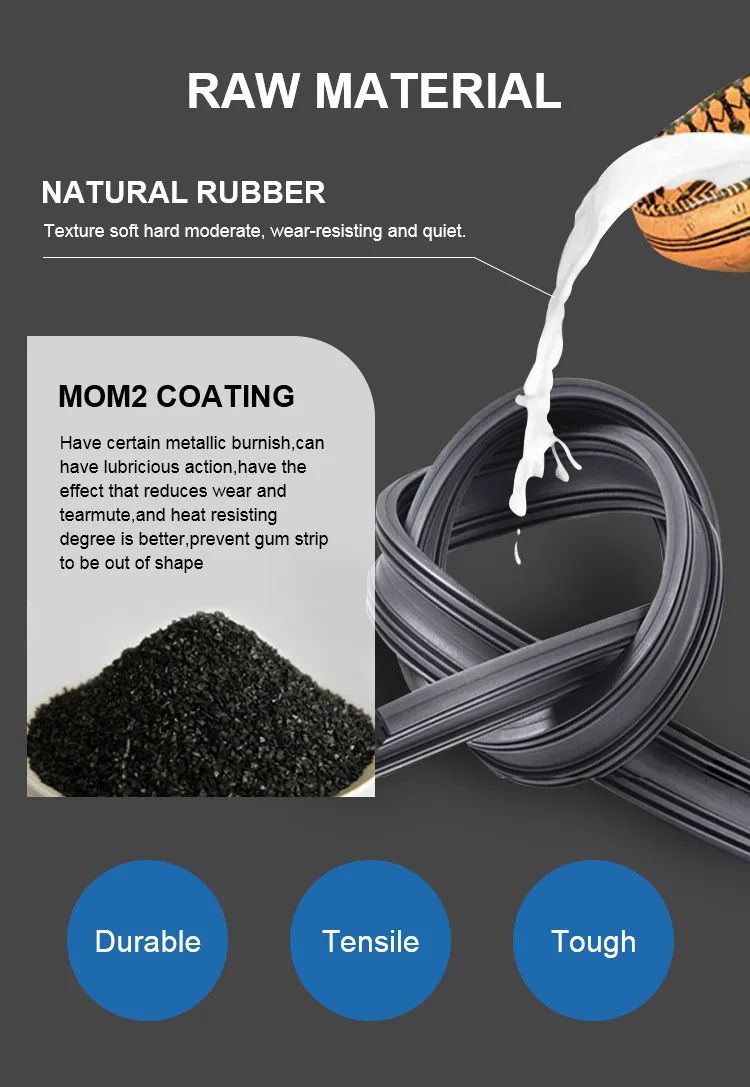
Natural Rubber (NR)
Natural rubber wiper blades use compounds based primarily on natural polyisoprene.
Natural rubber offers useful elasticity, tensile strength, tear resistance and dynamic fatigue properties.
These characteristics make it suitable for a component that repeatedly bends and reverses direction.
However, natural rubber is susceptible to ozone and oxidative aging unless protected by suitable additives.
A well-designed premium natural rubber wiper blade therefore depends on the complete compound rather than the raw polymer alone.
Synthetic Rubber and Rubber Blends
Synthetic elastomers may be used to adjust properties such as weather resistance, flexibility and processing behavior.
For example, EPDM is recognized for its ozone resistance, although its suitability for a particular wiping application depends on formulation and blade design.
Rubber blends can also be developed to achieve specific performance requirements.
No material should be considered superior without evaluating the finished product.
Silicone Rubber
Silicone wiper blades use silicone elastomers rather than conventional natural rubber compounds.
Silicone can offer favorable resistance to several environmental aging mechanisms and a broad temperature capability.
However, wiping performance also depends on friction, rubber geometry, surface treatment and blade structure.
For a more detailed comparison, see our silicone vs rubber wiper blades guide
3. A-Grade vs AA-Grade Natural Rubber: What Is the Difference?
Are A-Grade and AA-Grade Official Standards?
In the aftermarket industry, suppliers sometimes classify rubber as A-grade or AA-grade.
These descriptions generally represent internal supplier classifications, not universal international standards for finished windshield wiper rubber.
Different manufacturers may use different criteria.
Therefore, buyers should not assume that one supplier’s AA-grade rubber is equivalent to another supplier’s AA-grade product.
Typical Differences Between A and AA Rubber
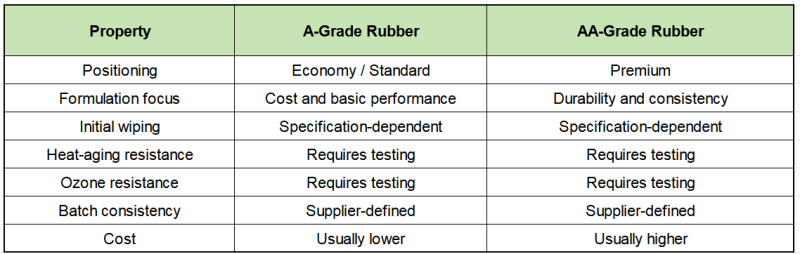
This is an illustrative commercial comparison, not a standardized grading table.
AA-grade rubber does not necessarily contain more natural rubber than A-grade rubber.
Both may use the same base polymer but different fillers, curing systems or protective additives.
How to Verify Premium Rubber Quality
Buyers should request measurable specifications, including Shore A hardness, tensile strength, elongation, heat-aging results and wiper blade durability testing.
Comparable samples should be tested under equivalent conditions.
The important question is not simply whether a supplier offers AA rubber, but whether the product consistently meets agreed performance requirements.
4. What Determines the Quality of a Natural Rubber Compound?
Natural Rubber Content and Reinforcement
A finished natural rubber compound contains more than natural rubber.
It typically includes reinforcing fillers, curing ingredients, processing aids and protective additives.
Carbon black can improve selected mechanical properties, including strength and stiffness.
However, excessive filler loading or poor dispersion may negatively affect flexibility.
Higher natural rubber content alone does not guarantee better wiping performance.
Vulcanization and Elastic Recovery
Rubber vulcanization creates crosslinks within the polymer structure.
In natural rubber systems, sulfur and accelerators may be used alongside other curing ingredients.
The curing process influences hardness, elasticity, deformation and aging behavior.
Controlled production conditions are therefore important for consistent wiper rubber manufacturing.
Anti-Aging Additives
Natural rubber can deteriorate under heat, oxygen and ozone exposure.
Antioxidants, antiozonants and protective waxes help reduce specific aging mechanisms.
Their effectiveness depends on the formulation and operating conditions.
A premium rubber compound requires a balanced protective system rather than simply a higher concentration of additives.
5. The Role of Coatings in Wiper Blade Performance
The base wiper blade rubber material is only part of the equation.
Surface coatings can significantly influence friction, wiping smoothness, noise and certain forms of wear.
Even two blades using the same natural rubber compound may perform differently because of their surface treatments.
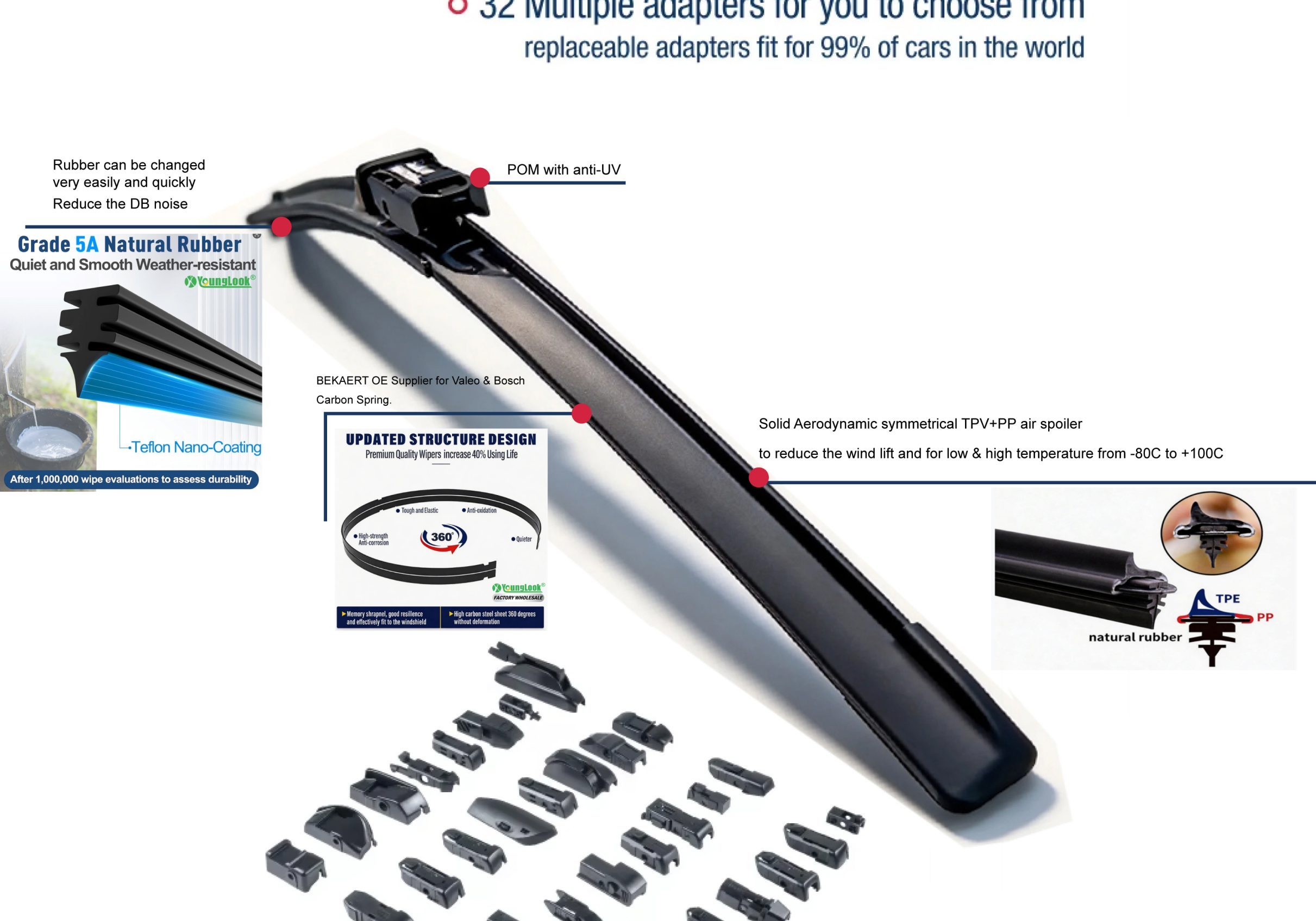
The three commonly discussed coating technologies are graphite coatings, silicone coatings and Teflon (PTFE) coatings.
Graphite Coatings
Graphite-coated wiper blades use a graphite-based lubricating treatment applied to the rubber surface.
Graphite helps reduce friction between the rubber edge and windshield.
Pros:
-
Reduces friction.
-
Helps minimise squeaking and chattering.
-
Improves initial wiping smoothness.
-
Generally offers a cost-effective solution.
Cons:
-
Effectiveness may decrease as the coating wears.
-
Performance depends on coating adhesion and uniformity.
Does not significantly improve the underlying rubber’s heat or ozone resistance.
Graphite is a practical option for standard natural rubber wiper blades where cost and wiping performance must be balanced.
Silicone Coatings
Silicone-coated wiper blades use a silicone-based surface treatment, sometimes applied to a non-silicone rubber substrate.
They should not be confused with blades made entirely from silicone rubber.
Certain treatments can provide lubrication or water-repellent effects.
Pros:
-
Can improve surface lubrication.
-
Some formulations provide water-repellent properties.
Certain silicone treatments resist environmental degradation.
Cons:
-
Coating may wear unevenly.
-
Some formulations may leave deposits or cause smearing.
-
Dirt and windshield contamination can affect performance.
-
Does not necessarily improve the underlying rubber’s aging resistance.
Silicone coatings can be useful, but their benefits depend on the product design and operating environment.
Teflon (PTFE) Coatings
Teflon-coated wiper blades use a surface treatment containing PTFE, or polytetrafluoroethylene.
PTFE is widely recognized for its low-friction properties.
Pros:
-
Provides excellent low-friction characteristics.
-
Helps reduce squeaking and chattering.
-
Supports smoother wiping movement.
-
May improve surface wear resistance.
-
Suitable for selected premium applications.
Cons:
-
May involve higher material and processing costs.
-
Performance depends on coating formulation and adhesion.
-
Coating effectiveness may decline with wear.
Does not automatically improve the underlying rubber’s UV or ozone resistance.
PTFE is an attractive option for premium natural rubber wiper blades, but its durability advantage should be established through comparable testing.
Graphite vs Silicone vs PTFE Coatings

No coating is universally superior.
For OEM wiper blade manufacturers, the best solution combines suitable rubber properties with a coating that performs consistently under the intended operating conditions.
6. How Does Rubber Quality Affect Wiping Performance?
Hardness and Flexibility
Rubber hardness is commonly measured using the Shore A scale.
Hardness influences how the wiping edge deforms under pressure.
Rubber that is too stiff for a particular design may cause unstable contact, while excessively soft rubber may deform too easily.
There is no universal ideal hardness for every wiper blade.
The appropriate specification depends on blade geometry, contact pressure and temperature.
Tensile Strength and Tear Resistance
Rubber tensile strength measures the stress a specimen withstands before failure during tensile testing.
Elongation at break describes how far the specimen stretches before breaking.
Tear resistance indicates how the material responds to cuts and crack propagation.
These properties help evaluate compound quality, but no single measurement guarantees excellent wiping.
Friction, Noise and Stability
The interaction between rubber and glass strongly influences wiping noise.
Unstable friction can contribute to squeaking or chattering.
Rubber formulation, surface coating and wiping-edge geometry all affect this interaction.
Blade structure matters as well.
Read our frameless vs framed wiper blade comparison to understand how different structures distribute pressure across the windshield.
7. How Is Wiper Blade Rubber Quality Tested?
Mechanical Property Testing
Professional testing includes hardness, tensile strength, elongation and tear resistance.
ASTM D2240 addresses rubber hardness, while ASTM D412 and ASTM D624 cover tensile and tear properties.
These measurements help manufacturers evaluate material consistency.
However, the test method, specimen preparation and conditions must be documented.
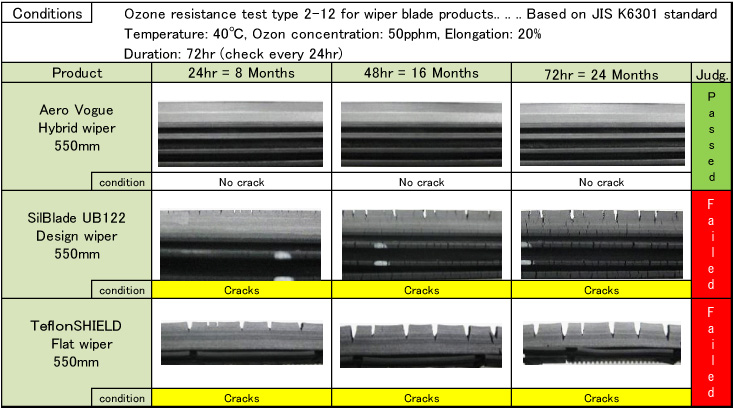
Heat Aging and Ozone Resistance
Rubber heat-aging tests evaluate property changes after controlled thermal exposure.
ASTM D573 describes a method for evaluating rubber deterioration in an air oven.
ASTM D1149 addresses ozone cracking under specified exposure conditions.
A statement such as “no cracks after 72 hours” is incomplete without the test temperature, ozone concentration and specimen strain.
Accelerated-aging results should not be converted directly into guaranteed service years.
Wiping Durability Testing
Wiper blade durability testing evaluates the finished product after repeated wiping cycles.
Manufacturers may examine streaking, noise, rubber wear and wiping quality at selected intervals.
SAE J903 provides relevant performance requirements and test procedures for applicable windshield wiper systems.
Internal tests can also help compare different rubber compounds and coatings.
YOUNGLOOK AA Natural Rubber Test Data
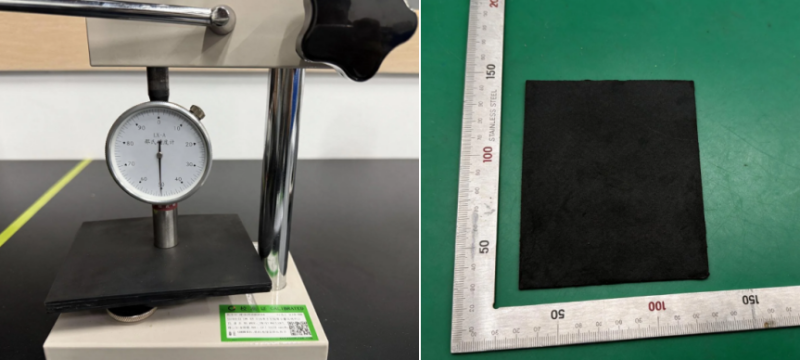
The following internal laboratory results were previously recorded for a YOUNGLOOK AA-grade natural rubber compound.
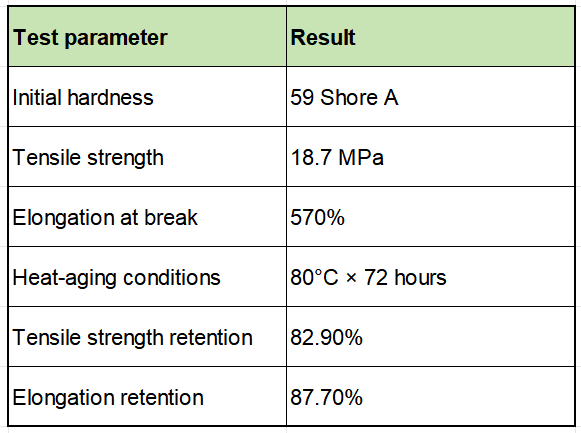
These results illustrate the measurable properties used in rubber evaluation.
They are sample-specific internal data, not universal AA-grade specifications or guaranteed results for every production batch.
For purchasing decisions, buyers should request the applicable product specification and available test documentation.
8. Natural Rubber vs Silicone: Which Is Better?
Performance and Durability
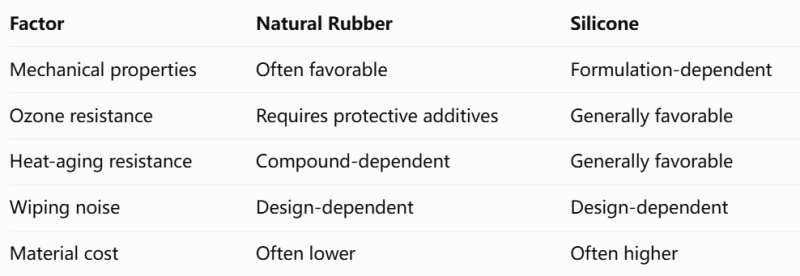
Both natural rubber wiper blades and silicone windshield wipers can deliver effective performance when properly designed.
Natural rubber offers favorable mechanical characteristics and cost efficiency.
Silicone generally provides strong resistance to several environmental aging mechanisms.
However, actual performance depends on the complete blade.
Does Silicone Last Longer?
Silicone may resist certain forms of aging better than conventional natural rubber.
However, it is not accurate to claim that every silicone blade lasts a fixed multiple longer.
The rubber formulation, surface coating, blade structure and operating environment all affect service life.
Choosing Rubber for Different Climates
Hot regions require attention to heat aging and ozone resistance.
Cold regions require suitable low-temperature flexibility and wiping performance.
Rainy markets require consistent wiping, friction control and wear resistance.
9. Why Do Wiper Rubber Blades Harden or Crack?
Common Causes of Rubber Aging
Wiper rubber aging may result from heat, oxidation, ozone exposure, mechanical fatigue and contamination.
These factors can change the material’s flexibility or damage the wiping edge.
Wear can also increase when abrasive particles remain on the windshield.
Can Hardened Wiper Rubber Be Softened?
Cleaning may remove surface contamination and temporarily improve wiping.
However, it cannot reverse permanent chemical aging or repair cracks.
Unapproved oils and solvents may damage rubber compounds or coatings.
If the rubber is cracked or permanently deformed, replacement is generally preferable.
How to Extend Wiper Blade Life
Keep the windshield clean, use suitable washer fluid and remove ice before operating the wipers.
Avoid wiping over heavily contaminated glass.
Regular inspection can help identify damage before visibility is seriously affected.
10. Replace the Wiper Blade or Just the Rubber?
When to Replace Only the Rubber
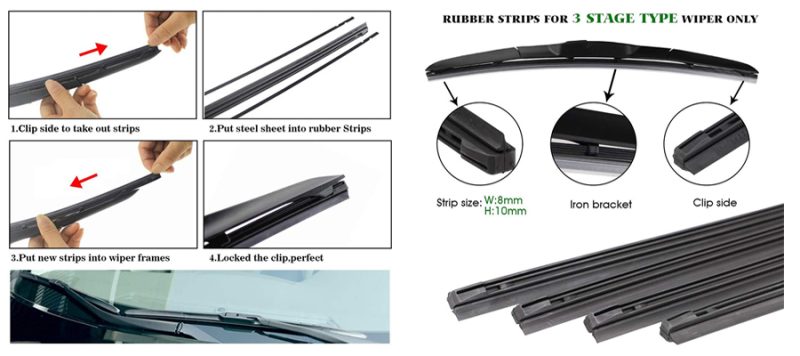
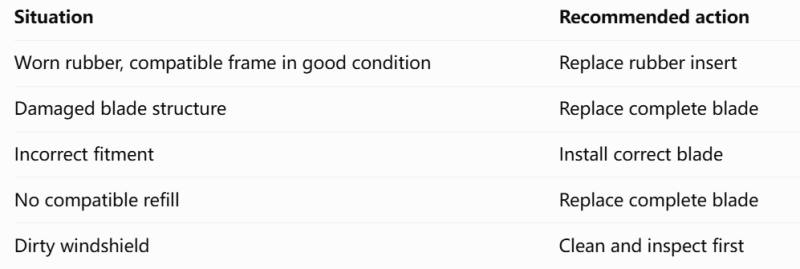
Replacing a wiper rubber insert can reduce cost and material waste when the blade supports compatible refills.
The supporting structure must remain in good condition.
The new rubber must match the required profile, length and retention system.
When to Replace the Complete Blade
A complete windshield wiper blade replacement is preferable when the structure is damaged, pressure distribution is poor or compatible refills are unavailable.
Some modern flat and hybrid blades are not designed for rubber-only replacement.
Rubber Refill vs Complete Blade
11. How Should OEM Buyers Choose Wiper Rubber Quality?
Select Rubber for Your Target Market
Economy products may prioritize competitive cost while meeting defined performance requirements.
Premium programs may justify higher material costs through verified improvements in durability, wiping stability or environmental resistance.
A reliable wholesale wiper blade supplier should help buyers select suitable materials rather than simply promote the most expensive rubber grade.
Evaluate Coatings and Test Results
Buyers should compare rubber specifications, coating technology, durability results and sample performance.
Important considerations include rubber hardness, tensile properties, heat aging, ozone resistance, friction behavior and finished-blade wiping quality.
For private-label programs, an approved reference sample and agreed acceptance criteria can reduce future quality disputes.
Work With an Experienced Wiper Blade Manufacturer
YOUNGLOOK supports global distributors and automotive aftermarket brands with OEM wiper blades, private label wiper blades and customized product development.
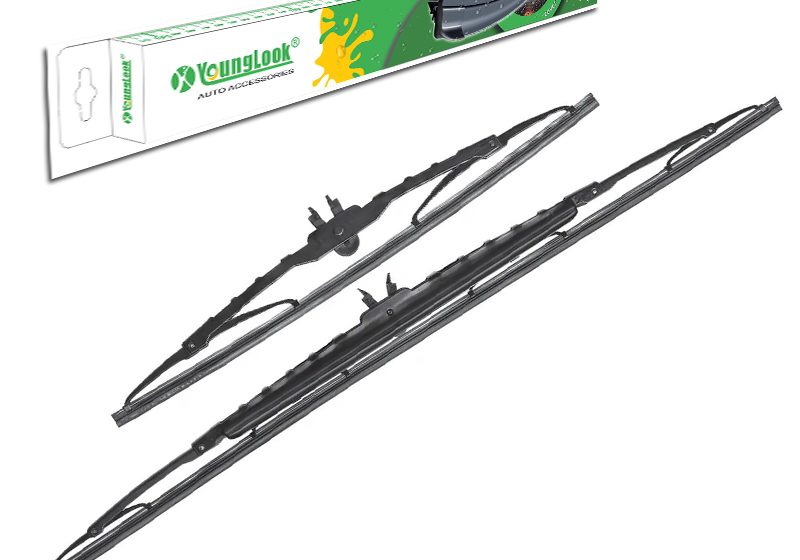
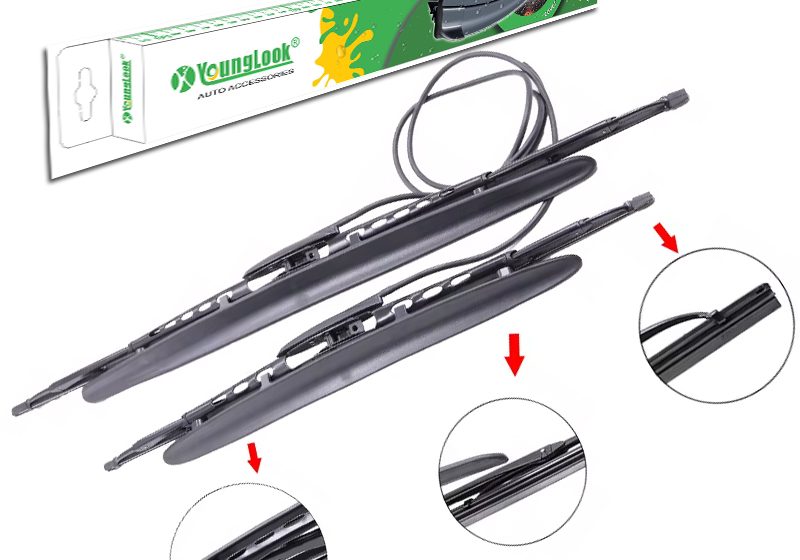
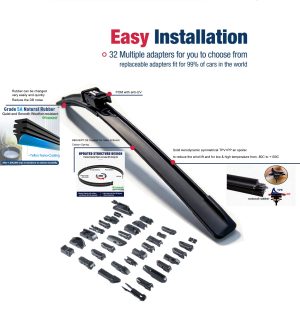
Our product programs include flat, conventional, hybrid, rear and multi-adapter windshield wiper blades.
Depending on project requirements, customization may include rubber material selection, blade design, adapters, logos and packaging.
Explore our OEM and wholesale wiper blade manufacturing solutions to discuss product specifications and sample requirements.
Conclusion
The quality of windshield wiper rubber depends on more than whether a product is labeled A-grade, AA-grade, natural rubber or silicone.
A reliable wiper requires the right compound, controlled vulcanization, suitable surface treatment and consistent manufacturing.
Graphite, silicone and PTFE coatings can improve specific aspects of friction and wiping behavior, but none can compensate for poor underlying rubber quality.
For automotive aftermarket buyers, the most reliable approach is to compare measurable specifications and finished-product performance.
The best wiper rubber is the material-and-coating combination that consistently meets the requirements of its intended application.
FAQ: Frequently Asked Questions About Wiper Blade Rubber
1. What is the difference between A-grade and AA-grade wiper rubber?
A-grade and AA-grade are generally supplier-defined classifications. AA-grade may represent a premium formulation, but the difference must be verified through material specifications and comparable performance tests.
2. Is AA-grade natural rubber better than silicone?
Not necessarily. Premium natural rubber may provide excellent mechanical properties and wiping performance, while silicone may offer advantages in certain environmental conditions. The finished blade design is equally important.
3. What is the best coating for windshield wiper rubber?
Graphite, silicone and PTFE coatings offer different characteristics. Graphite is commonly used for friction reduction, some silicone treatments provide water-repellent effects, and PTFE offers low-friction properties. The best option depends on the complete formulation and application.
4. Do Teflon-coated wiper blades last longer?
A properly formulated PTFE coating may improve certain friction and wear characteristics. However, it does not guarantee longer service life than graphite-coated or silicone-coated products without comparative testing.
5. Why do windshield wipers become hard and noisy?
Heat aging, oxidation, contamination and changes in rubber properties may contribute to stiffness and noise. Incorrect arm pressure, glass condition and blade geometry can also cause these symptoms.
6. How long do natural rubber wiper blades last?
Service life varies with climate, usage, rubber quality and maintenance. Regular inspection is more reliable than assuming a fixed replacement interval.
7. Can I replace just the wiper rubber?
Yes, when the existing blade is designed for compatible rubber refills and its supporting structure remains in good condition.
8. How can importers verify wiper rubber quality?
Buyers should request material specifications, laboratory reports, representative samples and relevant finished-blade durability results. Consistency between production batches is also important.
Related Articles
Learn more about wiper blade materials, manufacturing, durability and product selection through our technical resources.
1. Silicone vs Rubber Wiper Blades: Which Is More Effective? — Compare natural rubber and silicone materials.
2. How Are Windshield Wiper Blades Made? — Understand material selection, production and quality control.
3. Frameless Wiper Blade vs Frame Wiper Blade — Learn how wiper structure influences pressure distribution and wiping performance.
About the Author
Jacky | Wiper Blade Industry Specialist — YOUNGLOOK
Jacky has worked in the windshield wiper industry since 2008, with experience in automotive aftermarket sales, rubber materials, product selection and OEM/ODM development.
He focuses on helping international importers, distributors and private-label brands understand windshield wiper quality, manufacturing processes and sourcing requirements.
References
The following references cover rubber material testing, windshield wiper performance and coating technologies. Manufacturer resources provide application background rather than independent proof that one coating is universally superior.
1. SAE International — J903_202410: Ground Vehicle Windshield Wiper Systems. Wiper system performance requirements and test procedures.
2. ASTM International — D2240: Rubber Hardness. Durometer hardness testing.
3. ASTM International — D412: Rubber Tensile Properties. Tensile strength and elongation testing.
4. ASTM International — D624: Rubber Tear Strength. Tear resistance testing.
5. ASTM International — D573: Rubber Deterioration in an Air Oven. Accelerated heat-aging evaluation.
6. ASTM International — D1149: Ozone Cracking of Rubber. Ozone resistance evaluation.
7. Chemours — Teflon™ Materials. PTFE material characteristics and applications.
8. TRICO — Silicone Wiper Blades vs Rubber. Wiper material comparison.
9. TRICO — Wiper Refills. Rubber refill products and applications.
12. YOUNGLOOK — Internal Natural Rubber Laboratory Data. Hardness, tensile strength, elongation and heat-aging evaluation. Original test reports should be verified before publication.
Looking for a Reliable Wiper Blade Manufacturer?
Choose the right rubber quality, coating technology and wiper blade design for your market.
At YOUNGLOOK, we support automotive aftermarket distributors, wholesalers and private-label brands with OEM windshield wiper blades, premium natural rubber wiper blades, silicone wiper blade options and customized product development.
From rubber material selection and blade design to adapters, branding, packaging and sample evaluation, our team can help you develop a suitable product range for your market.
Contact YOUNGLOOK today to discuss your rubber specifications, OEM requirements and wholesale quotation.
Explore YOUNGLOOK OEM & Wholesale Wiper Blade Solutions
Contact YOUNGLOOK for Your Wiper Blade Program

Looking for a reliable supplier for frameless beam wipers, framed conventional wipers, hybrid blades, multi-fit wipers, or private-label products?
YOUNGLOOK can support B2B customers with product selection, sample development, application verification, OEM/ODM customization, adapter solutions, packaging, and bulk production.
Contact us today to discuss your target vehicle applications, request samples, review product specifications, or develop your own private-label wiper blade program.
Tell us your target market, vehicle coverage, blade sizes, estimated order quantity, and packaging requirements—and our team can recommend the most suitable wiper blade solution for your business.